
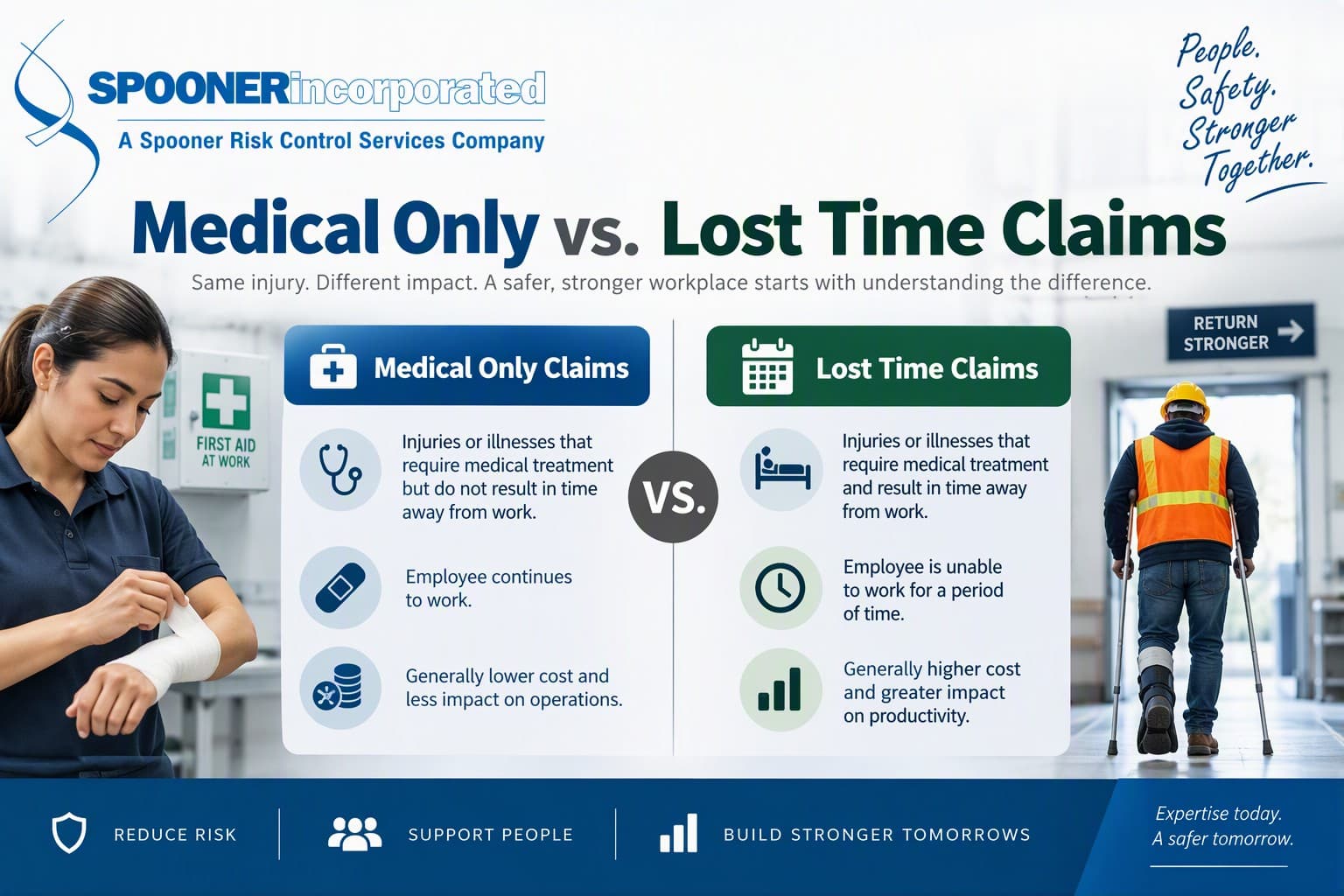
If you manage workers' compensation in Ohio, you've likely heard the terms "medical only" and "lost time" claims — but understanding exactly how they differ, and why that difference matters to your bottom line, is essential for keeping your experience modifier in check and your workplace running smoothly.
Medical Only Claims
A medical only claim is filed when an injured employee requires medical treatment but does not miss time beyond the day of injury — or misses 7 or fewer days. In these cases, the Bureau of Workers' Compensation (BWC) covers the cost of medical care, but no wage replacement benefits are paid out.
Because no compensation is paid for lost wages, medical only claims are weighted less heavily in your experience modifier calculation. That said, they still go on your record and can influence your premiums, so they shouldn't be dismissed as inconsequential. Prompt reporting and good injury management still matter.
Lost Time Claims
A lost time claim occurs when an injured worker misses enough work to qualify for wage replacement benefits. Once the employee's absence exceeds 8 days, the claim escalates and compensation payments begin.
Lost time claims carry significantly more weight in your experience modifier calculation than medical only claims. This is for a straightforward reason: they involve both medical costs and wage replacement costs, which together can be substantially higher. A single serious lost time claim can affect your premiums for 4 policy years.
Why the Distinction Matters for Ohio Employers
Understanding the difference between these two claim types helps you make smarter decisions around injury response, return-to-work programs, and cost containment. A few key considerations:
Experience modifier impact: Lost time claims are weighted more heavily, meaning they drive up your modifier — and your premiums — faster than medical only claims of similar medical cost.
Return-to-work programs: Offering modified or light-duty work can prevent a medical only claim from becoming a lost time claim, protecting both the employee's routine and your premium.
Claim reporting speed: Reporting injuries promptly to the BWC and your managed care organization (MCO) gives you the best chance to manage costs and direct quality care before a claim escalates.
Reserves and settlements: Lost time claims are more likely to carry higher reserves and involve longer claim lifecycles, making proactive management even more critical.
What You Can Do to Manage Both Types Effectively
Whether a claim is medical only or lost time, the fundamentals of good claims management are the same: respond quickly, communicate clearly with the injured worker, and work with qualified professionals to guide the claim toward resolution.
For lost time claims specifically, a strong return-to-work policy is one of the most effective tools available. Getting an injured employee back to meaningful, appropriate work — even in a modified capacity — reduces wage replacement costs, keeps the worker connected to the job, and signals to the BWC that you take recovery seriously.
Regularly reviewing your claims history with a TPA can also help you spot patterns, address repeat injury types, and identify opportunities to participate in BWC savings programs.
At Spooner Inc., we work with Ohio employers every day to help them understand their claims, protect their experience modifier, and build stronger safety and return-to-work programs. If you'd like to talk through your current situation or have questions about a specific claim, we encourage you to reach out — we're here to help.
Find out how much you could save.
Complete our online AC-3 form for a no-cost, no-obligation review of your Ohio workers’ compensation policy.